Pierre Lecomte du Noüy was a French biologist and philosopher.
According to Du Noüy evolution could not occur by chance alone and that on an average since “the beginning of the world it has followed an ascending path, always oriented in the same direction.” He accepted naturalistic evolutionary mechanisms such as mutation and natural selection but believed science could not explain all evolutionary phenomena or the origin of life.[9] According to his telefinalist hypothesis a transcendent cause which he equated with God is directing the evolutionary process.[6]
For you this Universe was created, for you this Earth was created, no doubt. And today you are at a situation where you have to get out of this illusion. The time has come, everything is right. But on a tree if you notice the most delicate stage is that of a flower. Flower is the most delicate thing. The roots are tough, extremely tough: they penetrate through the land, hardest possible land; they go through different rocks and find their ways. But when it comes to the flower stage, it’s a very, very, delicate stage: though the whole creation just waits for that time. The whole tree works it out, and the tree creates that beautiful flower. It’s waiting for that time, that blossom time, when the flowers have to become the fruit. Now that is the time, that precarious time, that beautiful time, that fantastic, dynamic time is. But we do not know how delicate it is, and that’s how, we really play too much with ourselves.
Before realisation, you have seen people who have come to Me who had terrible mental problems; who were mentally deranged people absolutely, epileptic and of serious type. They got cured, they got their realisation, they settled back. You have seen people with cancer, with blood cancer, all kinds of physical troubles: they got their blessings, they got their realisation, they have settled back. You have seen people from very false gurus who have damaged their being completely, who have been mesmerised, who have been absolutely misled and lynched and have been made into you can say just cabbages. Such people also came to Sahaja Yoga and tried and prospered.
But again it’s the flower stage one must not forget, and that is the time one has to be very careful. At the blossom time only, imagine, the times are so precarious that the gardener has to worry that there should not be a hailstorm! And all the satanic forces have worked up in their fullest form, with their greatest strength, with all their tricks and methods, to curb down the progress of this creation into its fruitful happening. At such [a] precarious time one has to be very aware of all the dangers that we can face.
This power is the expression of the desiring mood of Shri Adi Shakti, the Tamoguna in Her aspect as Shri Mahakali. By this power Pranava is transformed as existence power, which is the expression of the desire of Shri Adi Shakti to create. Desire means it is born without any concrete form in the heart of Shri Adi Shakti. It can say that it has not yet come into the light of expression, which is why it is also known as the darkness mood (Tamoguna). Desire is the emotion of the Divine Love of Shri Adi Shakti which gives Her the feeling to create. This then is the emotional expression of the Shri Adi Shakti and called the Shri Mahakali Power. This is chronologically the first mood that comes into play.
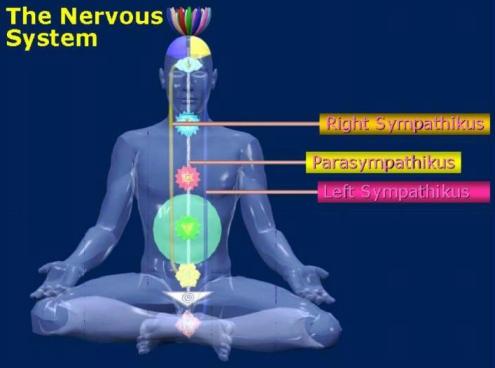
The Shri Mahakali Channel (Adi Ida Nadi) originates from the right side of the Primordial Brain, crossing over the Adi Agnya Chakra, and passes very near the Primordial Heart up to the Adi Mooladhara Chakra that controls the pelvic plexus in human beings. One of its sub-plexuses governs sex in man. This channel represents the Primordial Collective Subconscious Mind of the Virata. Its Presiding Deity is Lord Shiva whose seat is in the left chamber of the Adi Anahat Chakra, and who controls the existence channel (Adi Ida Nadi). This Anahat Chakra controls the cardiac plexus in human beings. The fumes of the activity of this channel accumulate in the Brain of the Virata forming the Primordial Superego. All that dies on this earth is collected through the Primordial Superego into the Primordial Collective Subconscious Mind which lies on the left side of the Virata. All human beings, animals and experiences pass into this realm on death.
Lord Shiva has control over the heart organ and is connected with the witness aspect of Almighty God as Shri Sadashiva. He is fully aware of the intentions of the Supreme Spirit of God (Paramatma). In the Body of the Virata, the heart of the Primordial Being is a living parabola emitting in three and a half coils the waves of ‘I-witnessing’ (Ishwari) power. The creation remains in existence as long as this heart continues to pulsate with the presence of Almighty God. When God wants to terminate the play of creation, it is Lord Shiva’s role to destroy it by stopping the pulsating in the Primordial Heart. Shri Shiva can also destroy the creation by His furious dance (Tandava) which expresses His temper. By His anger He emits waves in an anticlockwise direction, and when this happens, the Body of the Virata dissolves.
The just announced Nobel prizes for both Chemistry & Physics have gone to research related to the Carbon atom. The Nobel Prize for Chemistry went to three scientists for developing a toolkit to manipulate carbon atoms, while the Physics prize has gone to two Russian born physicists for their study on the remarkable properties of Graphene, an ultrathin form of Carbon.
They do not realize how loaded their statement is. For what we have seen in Graphene is only a small glimpse of the wonders that Carbon is capable of. Especially what awaits us in the very near future!
Before we reveal the form of Carbon that is going to change every aspect of our lives, so completely and so drastically, let us bring to your attention a few other related occurrences that have been making the news in the past weeks.
Recently there was a flurry of concern in the scientific circles regarding the discovery of the sun’s influence on the decay of radioactive elements on earth. It was found that some kind of strange emissions from the sun are causing matter to mutate on earth. Its influence on the decay rates of elements like Carbon-14 has been especially worrisome and unexpected. Carbon, as previously stated, is the basic building block of life as we know it. And Carbon-12 is the most abundant form of carbon accounting for about 99% of all known forms of Carbon. It is the isotope of Carbon that consists of 6 protons, 6 electrons and 6 neutrons. 6-6-6. Does that sound familiar?
After Oxygen, the second most abundant element in the human body is Carbon-12. On cremation, the body returns to its Carbon-12 state. After Hydrogen, Helium and Oxygen, which are all gases, Carbon-12 is the most abundant element in the Universe. Carbon-12 is also one of the five elements that make up the human DNA. Thus Carbon-12 is indeed the most crucial element as far as life as we know today, is concerned. This is probably what the writer of the Revelation meant when he said that 666 was the number of man (or number of the beast). It is the number of Carbon-12, which is the basis of Man’s physical body, which ties him to the physical universe. This is especially significant when we understand what transmutation awaits this Carbon-12, which will bestow Man such superhuman powers that will make every technological advancement till date, completely redundant!
Every secret has a time. A time to reveal. A time to celebrate. It is now time to reveal this secret of all secrets. The secret of Alchemy. The secret of the Philosopher’s stone, that which transmutes, in a symbolic sense, lead to gold. The secret of the Elixir of Life. The secret of Amrita or Ambrosia, the nectar of immortality! The secret of something we shall label, Ascentium, since its primary function is to aid the coming Ascension. To form a portal into the higher dimension.
The secret of Carbon-7!
Carbon-7 is the hitherto undiscovered isotope of Carbon, which has 6 electrons, 6 protons and only one neutron. It is the material equivalent of the Kundalini system as well as Metatron’s cube.
Like iron has the ability of sustaining a magnetic field around it, Carbon-7 has the uncanny ability to carry hyperdimensional fields, such as fields of thought around it. Thus it can amplify thought and other hyperdimensional fields, just as the iron and copper in a transformer can amplify magnetic fields.
Naturally, it is formed in the brains of spiritual adepts, when they have out-of-body experiences or perform other supernatural phenomenon such as bilocation or materialisation etc. During such time the glow or halo that is formed around the heads of these highly evolved beings is actually due to the excess neutrons produced when Carbon-12 transmutes to Carbon-7 inside their brains. However this Carbon-7 quickly decays to other stabler forms of matter. Hence it is almost impossible to detect Carbon-7 directly in the human body.
History and Religion has offered us many clues as to the identity of this most wondrous material through cryptic notations, symbols and enigmatic texts. But it had to veil it in the most puzzling language and symbols since this knowledge in the wrong hands could mean the destruction of this planet. Such is its power! In that case, you may ask, why we are revealing it now since the same risks are still prevalent. There are two main reasons for this revelation at this point of time:
1. We are now at the very threshold of the most significant shift humanity has ever experienced. It is the time for all secrets to be revealed. We have been holding on to this secret for a long time. And Nature has spoken through signs that the time for this secret too has come.
2. Although the atomic structure and the properties of this wondrous material are revealed here, it is extremely difficult to synthesize Carbon-7 in a laboratory, other than in expensive particle accelerators.
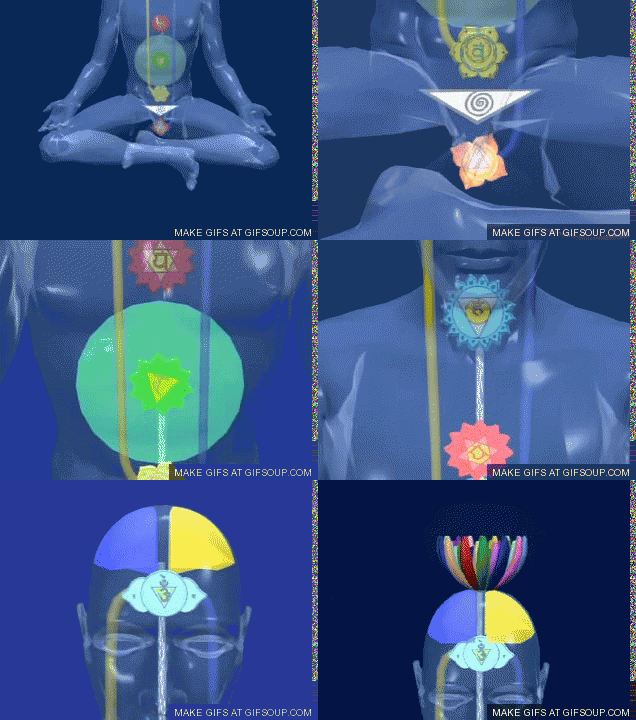
In the Kundalini system, this 6-6-1 configuration is represented by the male and female counterparts of the 6 lower chakras and the seventh chakra which is the neutral Sahasraara.
In Judaism, Metatron, who is considered to be God’s mediator with Man, is often represented by a cube formed by thirteen circles, comprising of 1 central circle, surrounded by 6 inner and 6 outer circles.
In Christianity, Da Vinci’s famous Last Supper, that depicted a moment before Christ’s Crucifixion and subsequent Resurrection and Ascension, is a symbolic representation of this 6-6-1 configuration where 6 apostles are on either side of Jesus Christ
It is interesting to note that both Kundalini, Metatron and Christ are vehicles of Ascension albeit in different spiritual systems.
This knowledge is known to advanced civilizations beyond our planet who have been watching over us for millennia. The release of this information at this point of time is also meant to accelerate Disclosure. This knowledge with the power to amplify one’s mind will make all technological progress and economic systems completely redundant since in the age of Manifestation and Abundance that awaits us post 2012, technology and money will have no meaning.
In the period post Disclosure, the Conditioning of Man will take place, during which time the collective mind of Man will undergo a quantum shift to expansiveness. A critical mass of humanity will crossover from an egocentric, material life to an egoless, lovefilled and spiritual life. The sun’s activity during this time will ramp up. The final transmutation that will be effected by the sun, will be the transmutation of the Carbon-12 in human DNA into Carbon-7. This will empower Man to survive the Final Double Cataclysm of the Superflare-Pole Shift and migrate to the higher dimensional New Earth.
“The other day I gave a simile of an egg. An egg is created by articulating it completely protected, till it reaches the complete stage of its rebirth, the Dwija, thenonly the mother bird pierces the egg and there is a rebirth of the chick. In the same way you are made, protected, so that you are made ready. Ultimately you reach a stage, where you are just ready to jump into another state, and it happens. In the incubators also, if you put these eggs, with the warmth, warmth is the love, and with that they grow, and at a point all of them hatch out.” – Shri Mataji-22nd March 1977













 YOGA
YOGA 

Recent Comments